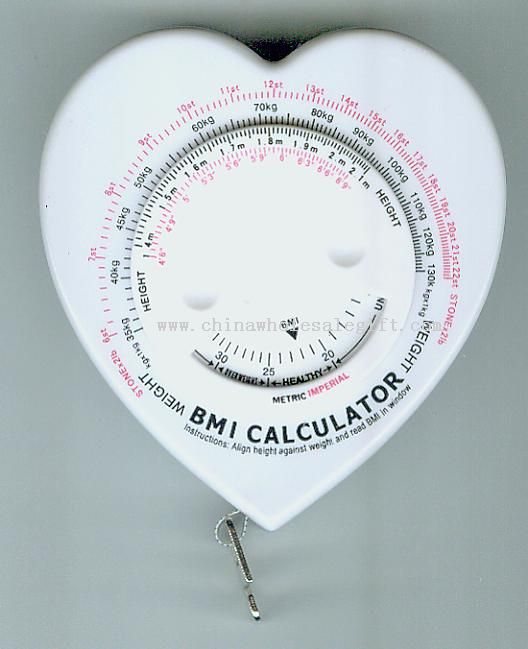
 BMI Calculator ResultsBM
I, Body Mass Index, is the most popular and simple way that health professionals use to determine if you are a
healthy weight. This article concerns how to interpret your results.
Summary
Body Mass Index:
<18:>25: Overweight
>30: Obese
Calculate Yourself
The calculation is simple, you can do it on a regular calculator. All you need to know
is your height and weight. If you want to use metric measurements, take your
weight in kilograms and divide it by your height in meters squared. If you use inches
and pounds instead, you need to multiply the result by 703 to get an equivalent
result. I am 6' tall and I weigh 180 lbs. 180/(72 x 72) x 703 = 24.4
Underweight
If your BMI is 18 or less, you are considered underweight for your height. My work
here is done. Just kidding.
Being underweight is a health problem, just as being overweight is. As Mr.
Weightless, I am dedicated to helping those at the other end of the spectrum, but if
you are underweight, here are a few tips to become healthier.
Don't try to do the opposite of everything I say to lose weight. You should still be
drinking plenty of water, for example.
This may seem obvious, but EAT MORE. Consume more calories than you expend.
Consume more protein. One main reason you may be underweight is lack of muscle
mass. Resistance training combined with a hefty increase in protein consumption
will put some meat on your bones.
The best way to consume more calories while keeping a balanced and healthy diet is
to order one of our meal replacement products, but instead of using the meal
replacement to replace meals, have a shake between other meals. You will be
getting more calories, more protein, but without imbalancing your intake of other
essential nutrients.
Normal Weight
If your BMI is between 18 and 25, you are considered normal weight for your height.
My work here is done. Really.
Actually, not really. Read the section below "BMI is not Enough" to find out why a
BMI that is in the normal range may not mean that you have no risk of disease. And
let's face it, for beach season you don't want your waistline to be "normal", you want
it to looked "ripped". You can benefit from my articles and products to strip off the
last remaining fat cells that are hiding your six-pack.
Overweight
If your BMI is over 25, you are considered overweight for your height. This is a
dangerous category because most people ignore the dangers. Technically, being in
the overweight category does not seriously predispose you to any health problems.
But that does not mean that you are healthy. And if you do nothing, you may just
slip into the "obese" category where your risks are great for developing heart
disease, diabetes and cancer.
There is a movement these days called "healthy overweight". People may have you
believe that if you can jog a mile and do some push-ups that you are healthy
despite being large. If you can do these things, that's great, but that doesn't make
you healthy. It just means you're not sick yet. The people who believe in the "healthy
overweight" basically want to take away any shame you might feel about your size,
to make you feel better and relieve some of your stress about your self-image. They
say that companies that sell diet products have exaggerated claims and made fat
people believe that any amount of excess fat is unattractive and unhealthy. That
may be true, we all see advertisements that make us feel unattractive compared to
models and actors, and we don't feel as healthy as the athletes we watch in sports.
But let's not kid ourselves: If you have excess fat, you are not as healthy as someone
without it. Fat, especially around the waist, is a health risk, and it does you no good,
unless you find yourself in the arctic. If you're a healthy overweight, lose some
weight and you'll be a healthier normal weight!
In some cultures, even in America, being overweight is a status symbol. Having a big
belly tells everyone that you make so much money that you can afford lots of food.
It also says that you don't do manual labour or work with your muscles because
your brain is all you need for your job. I think in most cultures this image is going
away, because the muscular superhero look that I'm helping you attain shows just
as much success in a different way.
Obese
If your BMI is over 30, you are considered obese. This is the category that is most
associated with hightened risk for all sorts of diseases. Risk is not a guarantee, you
might live to be 90, but the chances are slim.
I won't go into all of the health problems you are exposing yourself to, because I've
written another article about that. Read all about Obesity Statistics and Dangers on
my website.
I don't think anything more needs to be said. If you are obese, you need to start
losing weight right now to reduce your risks. Would you rather be dead? I don't like
scaring people, but I am scared for you.
BMI Alone is Not Enough
One important fact to consider is that BMI is based only on height and weight.
Therefore, BMI is not the best measure of your health. It is attractive because it's
fast and easy to calculate, not because it is perfect. If you have been lifting weights
and have a lot of muscle, your BMI may say you are overweight even though you
have little health risk. That is because your big muscles increase your weight, not
body fat.
To get a truly accurate picture of your health risks, you can try one or more of the
following other indicators.
Percentage bodyfat is the best measure. You cannot do this yourself without special
equipment. A doctor or nutritionist must do one of three tests: 1) use skin calipers
to measure "skin fold" at four or six points on your body, or 2) submerge you in
water to calculate your volume, or 3) use a device that measures BIA (bioelectrical
impedence analysis) by running a small electrical charge through your body.
Generally, men should have less than 18% body fat, and women less than 23%.
Another good indicator of health risk related to weight is waist-hip ratio. Stand with
stomach relaxed and measure the narrowest part of your waist, and divide that
number by the measurement at the widest point of your hips/buttocks. For women,
this number should be less than 0.8, for men it should be less than 0.95. If your
ratio is higher, then you carry excess fat around the waist, which carries a higher
health risk. However, this only really applies if your BMI is already over 25.
If your BMI is over 25, it is time to take action to improve your health. If your BMI is
over 30, you are already at risk for many diseases. Start one of our programs today.
By David McCormick